Simon Karlinsky. Review of Collected Works by Nikolai Gumilev, vol. II

- Simon Karlinsky
-
Authors
- Review
-
Source Type
- Sobranie sochinenii, 4 Vols
-
Publications
- Winter 1966
-
Date
- English
-
Language
Books Abroad 40:1 (Winter, 1966), 106-107
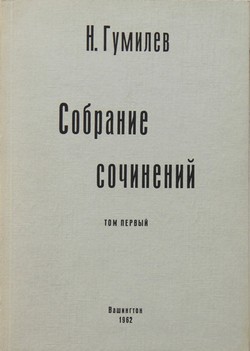
The second volume of Nikolai Gumilev’s collected works edited by Gleb Struve and Boris Filippov (see BA 37:4, p. 470) includes the last three collections the poet published during his lifetime, his narrative poems, his volume of paraphrases and adaptations of Chinese and Indochinese poets, and a large selection of his poetry not previously published in collected form. Together with the miscellanea found in various appendices, the first two volumes of this edition thus make available for the first time anywhere the entire corpus of Gumilev’s poetry and make possible a fair and balanced evaluation of this popular poet’s literary stature. As Professor Struve points out in his lucid survey of Gumilev's literary evolution, and as is amply illustrated by the poetry gathered in this second volume, there are several tenacious cliches about the nature of Gumilev’s work, which in the light of his later and more mature poems no longer make sense. Gumilev’s own tragic and violent death generated a legend, nourished by his earlier poetry of adventure and exploration, of Gumilev as a purveyor of dashing, heroic, and somewhat juvenile poetry that was supposedly redeemed only by the poet’s deliberate and precise craftsmanship.
With all his lyric poetry gathered and perusable in its entirety, we see that the Gumilev of the popular cliché represents only one aspect of this poet. Gumilev, the maître of the Acmeist school, with his championing of simple and direct poetic communication and his admiration for Theophile Gauthier, also turns out to be a particular aspect or mask of this protean poet – although in this case the Acmeist image has been fostered by literary historians rather than by the popular legend. The startling new image that emerges after one reads the second volume of his collected works is that of Gumilev the visionary neo-Symbolist mystic who tends to couch his visions in authentically surrealistic imagery. We have been aware of this side of Gumilev because of one of his most famous and most frequently anthologized poems, “The Lost Streetcar”; we can see now that this poem was not exceptional in his work, but that it represents a definite and major strain in the poetry Gumilev wrote in the last five years of his life. Nor is this the only unexpected side of Gumilev revealed by the second volume: there is an equally surprising orthodox religiosity; a gentle humor we do not usually associate with this poet; fine and subtle treatments of contemporary themes, as in the delightful brief novella in verse “When I Was In Love…” (pp. 193-95). We owe a debt of gratitude to the editors of this volume for making us realize that Gumilev is not only a brilliant poet, but a deep and many-sided one as well.
Simon Karlinsky
University of California at Berkeley