Leonid Rzhevsky. Review of Requiem by Anna Akhmatova
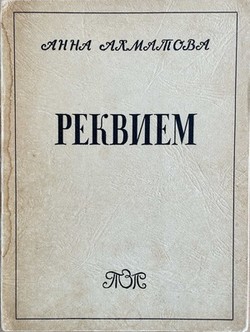
Books Abroad. Vol. 38. No. 3 (Summer 1964), 328-329
The history of this booklet of verses reminds us, in part, of Pasternak's Doctor Zhivago: it also appeared only in the West and was passed over in silence in its homeland. Unlike Pasternak's novel, however, these verses reached the West "without knowledge and agreement of the author," as their publisher, the Association of Russian Writers Abroad, in Munich stresses.
The author, Anna Akhmatova, is the oldest Russian woman poet (born in 1889). She developed creatively in the first two decades of this century, which sometimes are called "the Silver Age of Russian poetry." At the same time as the Symbolist, there was then a multitude of poetic currents and experiments, later extinguished by the October catastrophe. Akhmatova herself belonged to so-called Acmeism, a literary movement led by N. Gumilev, her husband, shot by a Soviet punitive squad in 1921.
Fourteen small poems, united by the title "Requiem," constitute a reflection of the terrible Thirties, the time of the most cruel police license and terror:
Zvëzdy smerti stojali nad nami
I bezvinnaja korčilas' Rus'
Pod krovavymi sapogami
I pod šinami čërnych marus'.
The Stalinist theoretician of the Party line in literature and arts, A. Zhdanov, subjected Akhmatova as well as her work, in his speeches, to savage and humiliating criticism as "vicious and unnecessary to the Soviet people." Soon afterward her son was arrested:
Éta ženščina bol'na,
Éta ženščina odna,
Muž v mogile, syn v tjur'me,
Pomolites' obo mne.
Akhmatova's Rekviem reflects the tragedy of many thousands of other Russian women, suffering the loss of their nearest ones. So writes Akhmatova about it in the preface to the booklet:
In the terrible years of the Yezhov terror I spent seventeen months in the prison lines in Leningrad. It happened that once someone recognized me. Then a woman with blue lips standing behind me who, of course, had never heard my name, broke loose from the insensibility so typical of us all and asked silently (we all whispered there):
– You can describe this?
And I answered:
– I do.
Akhmatova kept her promise. She transmitted the experiences of the other women, standing "in the terrible cold and in the heat of July" under the walls of Kresty, the prison of Leningrad.
O nix vspominaju vsegda i vezde,
O nix ne zabudu i v novoj bede,
i esli zažmut moj izmucennj rot,
Kotorym kričit stomil'onnyj narod,
Pust' takže oni pominajut menja
V kanun mojego pominal'nogo dnja.
The tragedy of the fourteen poems of the collection, written in this classically clear language, warmed by the spiritual expressiveness, so uniquely mastered by Akhmatova, is sharply felt by the reader. However, this tragedy is not only in the pain of those who survived; inwardly the poetry is directed in general toward the innumerable victims of the Stalinian terror over whose memory the official Soviet "rehabilitation" of our days passes in silence. This is, probably, also the reason why the booklet could not appear in the homeland of the author who dared so convincingly to recall these name-less victims by her poetical "Requiem aeternam dona eis. . . ."
Leonid D. Rzhevsky
University of Oklahoma
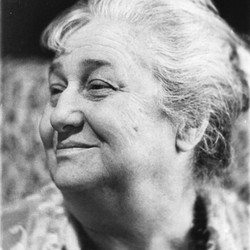
- Anna Akhmatova
- 23 June 1889 - 5 March 1966