Julian Symons. Bottoms up
- Julian Symons
-
Authors
- Review
-
Source Type
- Moscow to the End of the Line
-
Publications
- 3 December 1981
-
Date
- English
-
Language
The New York Review of Books (December 3, 1981)
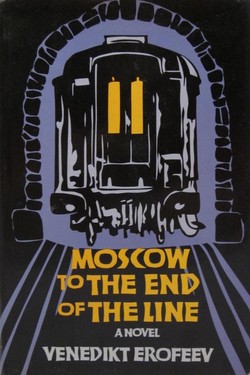
How, living inside a totalitarian state, do you write about it? One answer is that of Solzhenitsyn in Cancer Ward and The First Circle: you face it head on, making fictions almost directly out of personal experience. Other approaches, allegorical or symbolic, have landed those who made them in labor camps or mental hospitals. I don’t, however, recall any other comment on the nature of Soviet society so rawly comic as this short novel by Venedikt Erofeev.
Little is publicly known about Erofeev. He was, Vera S. Dunham tells us in her introduction, born in 1933 “in or near Moscow,” he “seems to have studied” at Moscow University, and has worked in various parts of the Soviet Union as coal stoker, janitor, railroad worker, and cable fitter. He has published nothing openly, but three works of fiction and “a parodic discourse on Russian existentialism” have appeared in samizdat form. The present book goes back to 1968, and we are told nothing about any later work. Erofeev may, as Vera Dunham says, be still winding cable today. It is also possible, since most of the information we have is derived from Erofeev himself, that it may not be true. Since he is apparently still at large, his name is presumably not Erofeev.
Moscow to the End of the Line is the record of a monumental drinking bout. The narrator, Venedikt Erofeev, otherwise Venya or Venichka, takes a train from Moscow’s Kursk Station to Petushki, the end of the line, where a real or imaginary girl is waiting for him. He is drunk when he sets out, and during the journey the drunkenness turns to total delusion and occasional delirium, so that at the end Petushki has become the Moscow from which he started; or perhaps he never set out, but was in Moscow the whole time. We leave him at the moment of his murder, but this also is presumably simply a nightmare.
Much of Venichka’s downward spiral to incoherence is purely comic, although the comedy may seem harsh in a country where alcoholism is a major problem. Take his solution of a problem known to virtually every drinker: the first five drinks are fine, and after five you are on top of the world, but from the sixth to the ninth there is a feeling of unease, the tenth is taken with eyes closed, and the eleventh is the point of no return, collapse or sleep. How can this unhappy consummation be prevented? Simple: you must drink shots six to nine “in an ideal sense – that is, drink them only in your imagination.” And then:
Having withstood the pause, take off directly on the tenth, just as with the ninth symphony of Dvorák, which is actually the ninth but conditionally called the fifth. The same with you – call your sixth your ninth and be sure that now you’ll reach maturity without hindrance, and do so from the sixth (the ninth) up to and including the twenty-eighth (the thirty-second). That is, reach maturity to the point beyond which lie insanity and piggishness.
This is then in one aspect a book not merely about drinking but for drinkers, from the first page where Venichka takes a glass of Zubrovka, followed by Coriander vodka, two mugs of Zhiguli beer, “an Albe de dessert port straight from the bottle,” and “two glasses of Hunters,” to the last, by which time he has played many variations on vodkas and beers, as well as such curiosities unknown to the Western world as “stout rosé,” which is apparently a red wine.
Venichka’s meditations, and his discussions with fellow passengers on the train, become more dizzyingly irrational as he grows drunker. A philosophical discussion on hiccupping (“Drink more, eat less. This is the best method of avoiding self-conceit and superficial atheism”), is succeeded by a series of recipes for drinks made with methylated spirits, furniture polish, lavender toilet water, athlete’s foot remedy, etcetera. Their concoction is treated with the seriousness of an oenophile discussing the merits of great burgundies on the nose and the palate.
In all this raw and clownish comedy, where’s the social criticism? It testifies to Erofeev’s skill that it should be embedded so deeply in the discourses about the nature and effect of alcoholic addiction, and also that it should be made with such indirection. A typical passage praises the eyes of Russians, round, bulging, and empty. In places where everything is bought and sold, the author reflects, eyes are always predatory and frightened. Those eyes see devaluation, unemployment, pauperism. All eyes in the world of Ready Cash are full of distrust. In the socialist Soviet Union, by contrast:
They’re constantly bulging but with no tension of any kind in them. There’s complete lack of any sense but, then, what power! (What spiritual power!) These eyes will not sell out. They’ll not sell or buy anything, whatever happens to my country. In days of doubt…these eyes will not blink. They don’t give a good Goddamn about anything.
There are ironic exaggerative passages of a similar kind about the Soviet work ethic, attitudes toward women, and homosexuality. It is worth describing the way in which the homosexual theme is introduced, because it is typical of Erofeev’s approach. The ticket collector on the train, Semenych, has long replaced the fines officially imposed on those lacking tickets by charging them instead one gram of vodka a kilometer. Venichka, however, has a special relationship to Semenych. Over many journeys he has avoided the vodka fine by recounting to the ticket inspector scenes from history, not excluding those of a sexual kind. By this time he has exhausted historical record, and moves into prophecy about the utopian future when “the torturer and the victim shall merge into a kiss, and spite, design, and calculation shall disappear from the heart… and the oppressed woman of the East shall throw off her veil once and for all.”
Semenych does not care much about the elimination of spite and calculation, but at the mention of an available woman he becomes excited and starts to strip, an action that is misinterpreted by the train travelers. Venichka explains:
I should tell you that homosexuality in our country has been overcome once and for all but not entirely. Or, entirely but not completely. Or else, entirely and completely but not once and for all. What do people think about now? Nothing but homosexuality.
This and other passages remind us that the book was written for Russian readers, while much dissident literature seems produced with an eye on Western reaction. No doubt we miss some of the points, and fail to catch much implicit savagery in the joking. It has to be said, though, that in a purely literary sense Moscow shows an outdated modernity which reflects how thoroughly Soviet writers are cut off from European experimental writing. Just as one was disconcerted to find Solzhenitsyn using in the newspaper extracts of August 1914 a technique very similar to the long-discarded “Camera Eye” of Dos Passos’s USA, so Erofeev is sometimes marked by the self-indulgent naughtiness characteristic of early surrealism, as in the coy warning about one chapter which after the first phrase contained “nothing but pure obscenity.” This proved irresistibly attractive to women, who read nothing else in the book, and has therefore been removed, so that the chapter now consists of only the opening phrase. The style, at least in translation, is often self-consciously “modern” in a jarringly jazzy way. Often very funny, and making its ironic points with great skill, Erofeev’s book is a social document of high interest, but hardly a work of art.