Jay Martin. Seventeen Years in Kolyma
The New York Times (October 25, 1981)
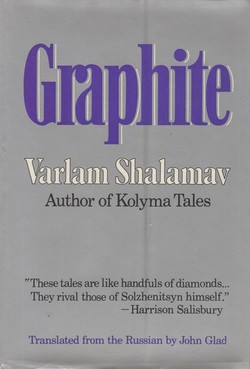
IN 1937 Varlam Shalamov, a rising young Soviet author, was sent to prison to pay for his ideological sins. He spent 17 years in the Kolyma region of northeastern Siberia, where the Soviet Government operated a vast gold-mining operation. He survived, not only to gain his freedom, but to describe his experiences. Last year a collection of his stories, smuggled out of Russia, was published under the title ''Kolyma Tales.'' The 24 sketches in the present collection, ''Graphite,'' are arranged in seven sections: Living, Eating, Working, Marrying, Stealing, Escaping, Dying. These headings tell us nothing at all unless we qualify them. We need to place words like ''Kolyma,'' ''labor camp,'' ''60 degrees below,'' or ''gold mine'' next to each of these ordinary human activities in order to get their true meaning.
''Living'' (at Kolyma) means corruption, pain, humiliation until no more humiliation is possible, and then death. ''Eating'' (in the labor camp) means boiling cedar needles for vitamin C, hopelessly gnawing on a frozen pig with scurvy-loosened teeth, and then starving to death. ''Working'' (in the gold mine) means fingers permanently crippled, suitable for grasping a pick but no longer able to close on a pen, then death. ''Death'' (in 60 degrees below) means countless corpses buried in ditches where the permafrost prevents decomposition; to the shin of each is attached a plywood tag with a number. Decay exists only in life.
Shalamov writes out of his personal disintegration; he plainly declares that the human qualities of sensitivity, morality, compassion became for him the sheerest fictions. Asked once by his work foreman to compose a supplicating letter for the boss's use, Shalamov failed, despite his desire for a reward: ''I was not up to the job - and not because the gap between my will and Kolyma was too great, not because my brain was weak and exhausted, but because in those folds in my brain where ecstatic adjectives were stored, there was nothing but hatred.'' In one sketch he imagines the last hours of Osip Mandelstam: ''His past life had been a fiction, a fairy tale, a dream; only the present was real.'' Every story revolves around degeneration, and the most striking example occurs in ''The Lepers.'' During World War II, the leprosariums were destroyed, and the lepers often sought refuge in the camps; at Kolyma, where frostbite and amputation were common, the lepers were not noticed.
Gogol's ''Dead Souls'' concerns a trick by which dead serfs are turned to profit by a clever manipulator. Shalamov's ''dead souls'' are the living. Their souls are dead, their bodies live on, and they become merely ''a by-product of the mine.'' In the first sketch in ''Graphite'' - ''The Businessman'' - a certain Kolya trades his food ration for a dynamite capsule, then bargains for the rations of two of his friends in exchange for offering them the inestimable benefit of joining him in holding the charge and destroying their hands. ''Kolya's happiness began the day his hand was blown off,'' for thereafter he would no longer be obliged to work in the mine.
In ''Handwriting'' Chris is summoned to headquarters, expecting to hear his death sentence pronounced, but on his way there he is elated to find a few turnip peels frozen in the snow, and he stuffs them in his mouth. In ''Berries'' Shalamov portrays himself as one of the dead souls. Giving an account of a beating he received, he remarks offhandedly: ''Fadeev's booted foot kicked me in the back, but a sudden warm feeling came over me, and I experienced no pain at all. If I were to die, it would be all the better.'' Nearly everyone in the book shares that feeling.
Intellectuals and ideologues, Shalamov suggests, are the most vulnerable to degradation. The prisoners in the foreground of his account are politicals - university professors, journalists, engineers, mayors, writers - while in the shadows hover the criminals, who are better organized and more secure. In ''The Golden Taiga'' the narrator chooses the lowest bunk: ''It's cold down here, but I don't dare to crawl higher, where it's warmer, since I would only be thrown down. ... If there should be a fight for the lower bunks, I can always crawl under them.'' The only likely survivors of the camp are the hardened criminals, who arrange things so that they can refuse to work, and the weakest intellectuals, who cannot work. Obviously, this observation has the force of a parable about power relations in the Soviet state, but it is also perhaps a troubling and accurate description of general reality, which Shalamov wants us to keep in mind.
''Graphite'' raises the question of how it is possible for the imagination to prevail under certain appalling circumstances. How can a man experience for a long period a completely dehumanizing existence and then write about it? If a person becomes a function of his labor, if he becomes alienated from all that as a human being he had held important, if his beliefs are crushed, his morals ridiculed and his yearnings reduced to dreams of bread, what will sustain his creativity?
That ''Graphite'' exists tells us that, despite such degradation, Shalamov survived. There are reserves, even against Kolyma - if one is lucky enough to prevail physically. ''I know,'' Shalamov writes, ''that everyone has something that is most precious to him, the last thing that he has left, and it is something which helps him to live, to hang onto the life of which we were being so insistently and stubbornly deprived. ... my last thing was verse.'' Literature, he implies, was fused with passion. Literature was his way to survive. Literature became his way of hating, and hate was the last emotion left to him before indifference. Most of all, literature was his way of remembering that he had once been human.
But despite it, the evidences of some moral, imaginative and mental degeneration are certainly apparent in this collection, and the translator, John Glad, does not do Shalamov a service when, in his foreword, he compares him to Chekhov for his ''objective, dispassionate narration.'' True, several pieces here might be superficially compared not only to Chekhov, but also to Nikolai Leskov, Anatole France, Turgenev, Andreyev and Baudelaire. But the sketches are not perfectly formed. Given Shalamov's trauma, this would perhaps be too much to expect, or even want. Any author who told us that his humanity had been crushed and proceeded to compose cool, crystalline stories would likely persuade us that he was making unwarranted claims on our sentiments.
Brief as they are, these pieces really are ragged fragments, scribbles - like the graphite scrawls on the plywood identification tags of the dead bodies in the camps. They wander about, looking for some other subject than death and degradation. Taken all together, they present no consistent picture. Certain characters do reappear - or is it just that their names are the same? Even the author's first-person narrative voice cannot provide a steady center. Like the landscape gardeners of the late 18th century, Shalamov builds ruins. The sketches remain fragments because they are about fragments - of men, of society, of dreams.