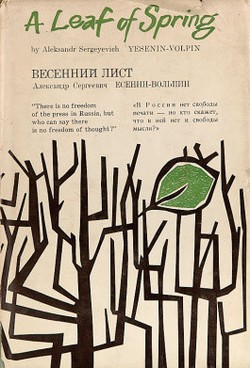
George Gibian. Review of A Leaf of Spring by Aleksandr Esenin-Volpin

- George Gibian
-
Authors
- Review
-
Source Type
- A Leaf of Spring
-
Publications
- June 1962
-
Date
- English
-
Language
Slavic Review 21:2 (June 1962), 371-373
This volume belongs to the growing list of works written in Russia by Russian authors which have been published abroad but remain unpublished in the USSR. The best known are Zamyatin’s We and Pasternak’s Doctor Zhivago; the most recent, the essay on socialist realism published in 1959 in L’Esprit and Dissent, “The Trial Begins” in Encounter, January, 1960, and the poems in the May-June, 1961, issue of Problems of Communism.
Aleksandr Yesenin-Volpin was born in 1925, the son of the poet Sergei Esenin. He has become known in the USSR and abroad as a mathematician and logician; he has published scholarly papers in his field. He is also the author of poems which caused his arrest in 1949 and earned him a five-year sentence to Karaganda. He possesses a candidate’s degree and conducted a seminar in mathematical logic in Moscow, but was officially judged mentally unbalanced. He was arrested a second time in 1959 (after being refused permission to accept an invitation to an international congress of mathematicians in Warsaw), and at the time of the publication of A Leaf of Spring, according to his editor, was in prison somewhere in the Soviet Union.[1]
A Leaf of Spring contains poems and “A Free Philosophical Treatise,” written by Yesenin-Volpin in great haste when an opportunity presented itself to him to send the manuscript abroad secretly. In the essay he presents briefly his opinions on a variety of subjects: determinism, the question of reality of being, materialism, and the existence of God. He rejects all dogmatism. Without using the term, he reveals himself to be a pluralist. He condemns Christianity, communism, and every culture that demands from its “adherents … some kind of a unity of views, without which it would disintegrate.” He stands a declared skeptic. Towards the end of the essay he launches into a not entirely clear or satisfactory treatment of the problem of death. At several points he attacks Marxism; he makes positive references to Sigmund Freud and the work of Western philosophers.
Lacking development and substantiation and covering many topics sketchily, the essay is not really a philosophical treatise. It is impressive as a document of the love of freedom. Its author concludes: “Every student in Russia who has arrived at philosophical skepticism by his own thinking can consider himself a new Columbus. … There is no freedom of the press in Russia, but who can say that there is no freedom of thought?” Yesenin-Volpin, aware of his isolation from intellectual life in the West, alludes in a postscript to the possibility that the contents of his essay in translation may seem “familiar to everyone and for this reason uninteresting.” Its greatest interest indeed lies not in any great originality but in its demonstration of how a young Russian thinker rejects conformity and strives towards independent conclusions. His inquiring skepticism is the lonely man’s weapon against the state’s totalitarian pressures.
The editor seems to have had trouble with the author’s logical symbols. On pages 168-69 he appears to have printed the figure 7 instead of the symbol for negation, and on page 113, to have substituted the symbol representing “if-then” for the symbol of identity. The translation contains inaccuracies.
The thirty-one poems range from works written when Yesenin-Volpin was only fifteen years old to translations and an adaptation of Poe’s “Raven,” endowed with a message of political rebelliousness. Particularly the earlier poems are derivative, reminiscent of both Mayakovsky and Esenin. The subjects are nature, “hooliganism,” alcoholism, and frequently death and insanity. Several of them are open statements of anti-Stalinist, anti-Soviet, and anti-Russian sentiments. A note of loneliness and rejection, familiar to us from Esenin and Mayakovsky, sounds in several poems. The poet lashes out violently against the insanity of the world around him, as in a poem written in September, 1941:
Я молчал и не верил,
Что сжигают Варшаву, Париж и Москву
Ради стран или денег:
Просто бьется в припадке, кусая траву
Великан-шизофреник.
The distraction and violence which the poet expresses in some of his works may be understandable responses to the horrors of the age in which he has lived, yet occasionally they emerge as direct outcries instead of poetic statements.
The Russian texts of the essay and poems and their translations are printed on facing pages. Let us hope other publishers will follow this praiseworthy method. However, stress marks, at least in the poems, would have been welcomed by readers with moderate Russian, and it is difficult to see any usefulness in giving pages of mere transliteration of Yesenin-Volpin’s Russian versions of Baudelaire and Poe, instead of the French and English original texts.
Yesenin-Volpin’s talent is not comparable to Mayakovsky’s or Sergei Esenin’s, but his poetry is stirring because of his courage and love of freedom. The poet sees himself as “mukha v spichechnoi korobke,” and before he lapses into silence, he insists on having his say about what he hates and loves. His alienation from his surroundings is such that he repeatedly speaks of his hatred for Russia: “I ia khotel by plyt’ na parokhode / Tuda, gde more russkikh ne vidalo.” Among his best poems are the title poem, “Leaf of Spring,” and “The Heart is Broken.”
It is not easy under any circumstances to be the son of a famous father. This moving little book shows what it means to be a radical skeptic, a rebel, a son of Sergei Esenin – and to live in Soviet Russia.
George Gibian
Cornell University
[1] According to information contrary to that supplied by the editor, the official charge after Yesenin-Volpin’s arrest in 1949 was attempting to escape from the USSR. His second confinement, in 1959, was called custody for “mental instability.” A report received in the spring of 1962 said that he had been released again and was living in Moscow. The fact that trustworthy sources confirm that Yesenin-Volpin suffers from spells of mental illness raises the question whether the publisher acted wisely in publishing the present volume even upon its author’s urging.
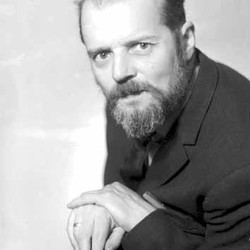
- Aleksandr Esenin-Volpin
- 12 May 1924 - 16 March 2016
- Andrei Sinyavsky
- 8 October 1925 - 25 February 1997